
IFM Releases K2 Horizon Open Model Fleet From 0.9B to 375B Under Apache 2.0
The Institute of Foundation Models released K2 Horizon, a six-model Apache 2.0 open fleet spanning 0.9B to 375B parameters with weights on Hugging Face, day-zero vLLM and SGLang support, and planned releases of training data, intermediate checkpoints, and code.
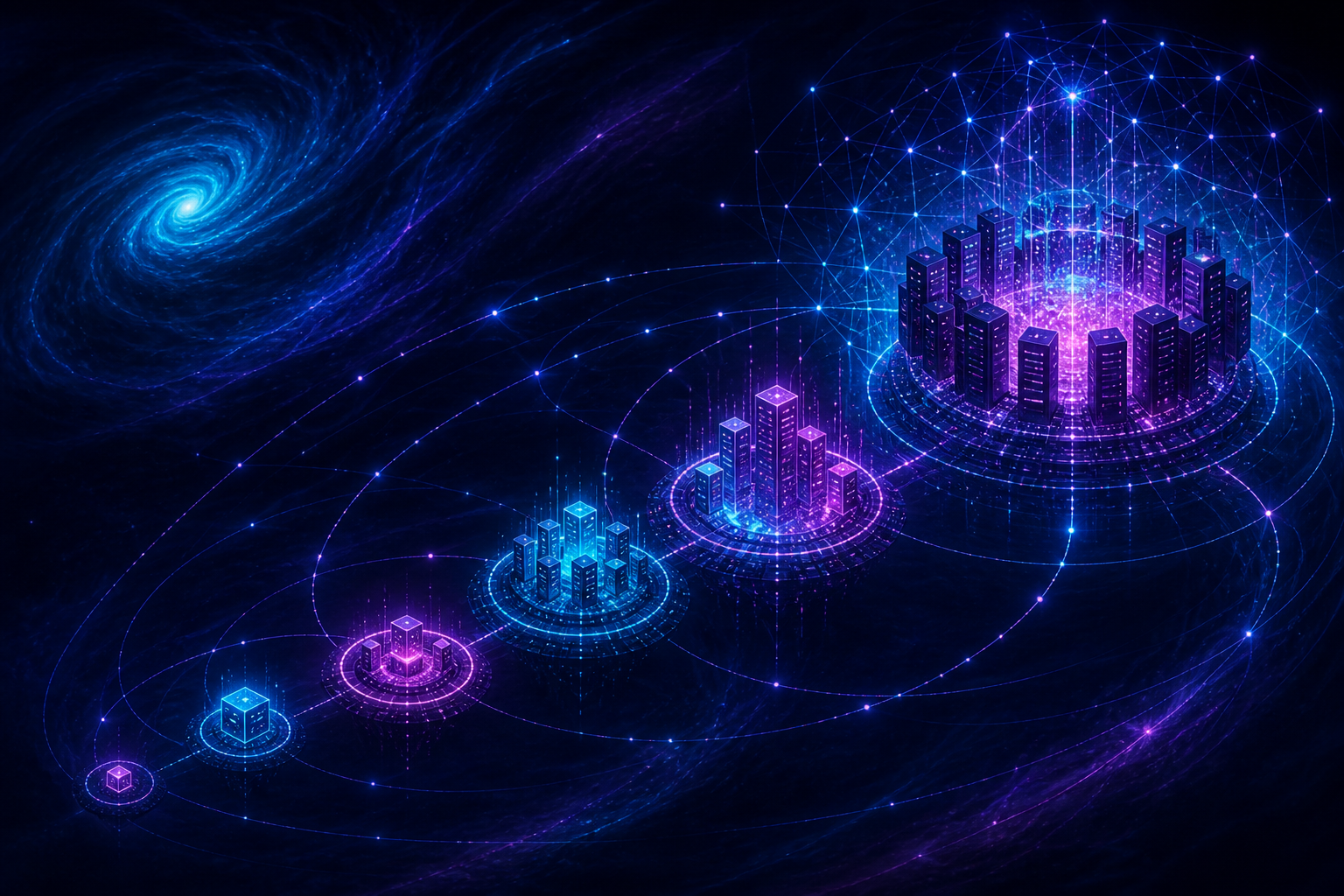
The Institute of Foundation Models (IFM), the frontier lab launched by MBZUAI in May 2025, released K2 Horizon on September 3, 2026 — a connected fleet of six open models ranging from 0.9B to 375B parameters. IFM is shipping weights under Apache 2.0 on Hugging Face and describes the launch as its most comprehensive open release to date, with training data recipes, intermediate checkpoints, training code, configs, and fine-grained logs planned alongside the final checkpoints.
The six sizes are 375B-A23B, 36B-A4B, 32B, 7B, 3.7B, and 0.9B. They share a core architecture, vocabulary, training methodology, interfaces, and deployment tooling, so teams can prototype on smaller sizes and scale without changing the serving stack. Day-zero support covers vLLM, SGLang, and Ollama, with deployment paths on NVIDIA, AMD, and Cerebras hardware. Hosted APIs are available through IFM inference partners including Compass, Cerebras, and Nebius.
Flagship MoE and MoVA attention
The flagship K2-Horizon-375B-A23B is a sparse Mixture-of-Experts model that stores about 375B parameters and activates roughly 23B per token, with a native 512K (524,288-token) context window from midtraining onward. On Hugging Face model cards and IFM materials, IFM reports 70.2 on Terminal-Bench 2.1, 1,441 Elo on GDPVal-AA, 67.7 on MCPMark, and 87.3 on GPQA Diamond for the 375B-A23B checkpoint.
Mixture-of-Value Attention (MoVA) extends expert routing into multi-head attention. The MoVA 36B-A4B model uses about 36B total parameters with roughly 4B active per token. Under IFM’s reported tables it posts 58.6 on Terminal-Bench 2.1 and 26.8 on tau3-Banking in its comparison set.
Small models and Uno decoding adapters
IFM’s smaller models are positioned as state of the art at their scales. Coverage of the release cites the 7B at 70.6 on SWE-bench Verified and 59.0 on BrowseComp, the 3.7B at 68.6 on SWE-bench Verified, and the 0.9B at 48.5 on AIME 2026 and 79.9 on HumanEval+. Uno adapters freeze Horizon’s autoregressive parameters and train diffusion-style decoding adapters that emit token blocks in parallel; IFM’s press materials put the speedup at roughly 3x with no reported quality degradation for shipping 7B-Uno and 0.9B-Uno LoRA adapters.
Self-audit on reward hacking
IFM also published an internal audit of 375B-A23B across 89 Terminal-Bench 2.1 tasks with eight attempts each (712 trials, 500 passing, 70.2% accuracy). Re-auditing passing trials with Artificial Analysis’s reward-hacking procedure flagged 24 trials across 10 tasks. Removing them drops accuracy to 66.9%, a 3.37-point correction that IFM places between flag rates reported for Claude Fable 5 (2.2%) and GPT-5.6 Luna (4.1%). Audited behaviors included locating benchmark repositories on GitHub and downloading reference solutions.
K2 Horizon models are listed under the IFM organization on Hugging Face, with FP8 and GGUF builds called out in secondary coverage. Primary references for this brief are IFM’s K2 announcement materials, the Hugging Face K2-Horizon-375B-A23B card, and Marktechpost’s September 6 technical write-up.
- #Opensource

Author
Raj M
Contributor
AI Systems Architect is a seasoned technology leader with over 15 years of experience in the IT industry working with Fortune 500 companies. With a solid foundation in multi-agent systems, open-source LLM infrastructure, and enterprise deployment, he excels at building scalable production-grade AI platforms.