
GitHub Outlines Multi-Layered Security Architecture for Agentic Workflows in GitHub Actions
GitHub has detailed the underlying security architecture designed to safely run non-deterministic AI agents within its GitHub Actions continuous integration and continuous delivery (CI/CD) environments. In a technical overview published on March 9, 2026, researchers Landon Cox an
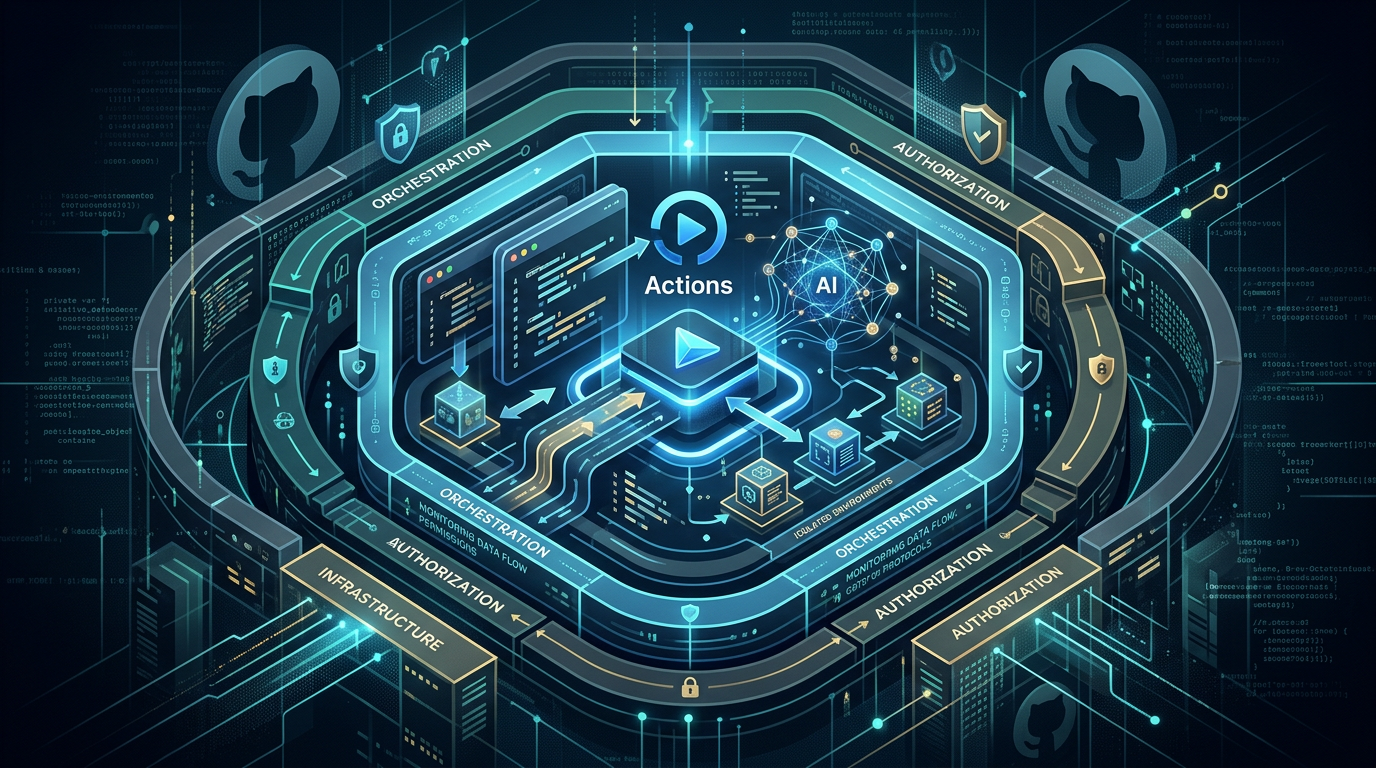
GitHub has detailed the underlying security architecture designed to safely run non-deterministic AI agents within its GitHub Actions continuous integration and continuous delivery (CI/CD) environments. In a technical overview published on March 9, 2026, researchers Landon Cox and Jiaxiao Zhou explained how the platform addresses the security challenges of autonomous agents. The security framework isolates agent runtime execution, blocks direct access to authentication secrets, and intercepts potential write operations to prevent unauthorized repository modifications.
The security design builds on the premise that standard CI/CD setups—which rely on a shared, highly permissive trust domain—are structurally incompatible with autonomous AI agents that consume untrusted runtime inputs. To mitigate risks like prompt injection, GitHub’s architecture isolates agent tasks and separates open-ended code generation from governed workflow execution.
The Three-Layered Defense-in-Depth Model
The platform’s security framework organizes agent execution into three separate structural layers, designed to contain failures and limit potential exploit paths:
- Substrate Layer: Positioned directly on the GitHub Actions runner virtual machine (VM), this layer relies on trusted containers to isolate components. It handles the mediation of privileged operations and system calls, enforcing communication boundaries at the kernel level to prevent a compromised container from accessing the wider VM.
- Configuration Layer: This layer uses declarative artifacts and toolchains to define which components load, how they connect, and what privileges they hold. It controls the loading of externally minted credentials, such as API keys and GitHub access tokens, ensuring they are only routed to authorized containers.
- Planning Layer: Rather than managing system connectivity, this layer coordinates the sequential flow of tasks. It structures workflows into staged data exchanges and feeds outputs through a designated evaluation pipeline.
Preventing Agent Access to Secrets
Standard GitHub Actions runners place sensitive credentials—including API keys and authentication tokens—in environment variables and configuration files that are accessible to any running process on the VM. Because AI models are susceptible to prompt injection, a compromised agent could potentially query these variables or files and leak secrets via public pull requests, issues, or external network requests.
To eliminate agent exposure to credentials, GitHub implements several structural boundaries:
- Network Isolation: The agent container runs within a private network configured with a strict firewall.
- Model Proxying: Large language model (LLM) authentication tokens are stored exclusively in an isolated API proxy container. The agent container has no direct access to these tokens and must route all model traffic through this proxy.
- The Model Context Protocol (MCP) Gateway: Model Context Protocol (MCP) credentials reside in a dedicated, trusted MCP gateway container. The gateway launches the necessary MCP servers on behalf of the agent, keeping the underlying authentication material hidden from the agent itself.
- Chroot Jail and Volume Mounts: To allow the agent to read local compilers and host files without giving it full run of the file system, the host VM’s file system is mounted read-only at
/host. Selected paths are overlaid with empty temporary file systems (tmpfs), and the agent is confined to a chroot jail rooted at/hostto restrict its writable and discoverable footprint.
Staging and Content Verification for Repository Writes
To prevent prompt-injected or malfunctioning agents from spamming repositories with unwanted issues, comments, or pull requests, the workflow compiler decomposes tasks into explicit stages. Each stage defines active permissions, emitted data artifacts, and allowed downstream consumers.
During execution, agents can read repository states via the GitHub MCP server, but any write commands are intercepted and buffered by a specialized “safe outputs” MCP server. Once the agent process terminates, these buffered writes undergo a series of automated safe outputs analyses.
This safety pipeline allows repository administrators to restrict the types of write actions permitted, set numeric limits on the quantity of created objects (such as restricting an agent to a maximum of three pull requests per run), and sanitize content to remove unauthorized URLs or pattern matches. Only changes that successfully pass through this entire pipeline are applied to the repository.
Pervasive Logging at Trust Boundaries
To assist with post-incident analysis and policy validation, GitHub’s agentic framework implements monitoring and logging at every primary trust boundary:
- Firewall Layer: Logs network-level and destination-level connection attempts.
- API Proxy: Captures model request/response metadata and authenticated API transactions.
- MCP Gateway and Servers: Log all tool invocations and operational requests made by the agent.
- Agent Container: Uses internal instrumentation to monitor and audit sensitive container activities, such as access to local environment variables.
These logs provide the forensic data required to reconstruct execution paths and detect anomalous agent behavior. The logging infrastructure is also designed to support future information-flow controls, including safety policies that enforce access rules across MCP servers based on the visibility of repository objects and the roles of their authors.
- #Cyber Security

Author
Raj M
Contributor
AI Systems Architect is a seasoned technology leader with over 15 years of experience in the IT industry working with Fortune 500 companies. With a solid foundation in multi-agent systems, open-source LLM infrastructure, and enterprise deployment, he excels at building scalable production-grade AI platforms.