
NVIDIA Launches BioNeMo Agent Toolkit to Equip AI Agents with Life Sciences Tools
NVIDIA has announced the release of the BioNeMo Agent Toolkit, a software suite designed to provide artificial intelligence agents with specialized tools and skills for life sciences research. Announced on June 23, 2026, the toolkit integrates over a decade of the company’s life
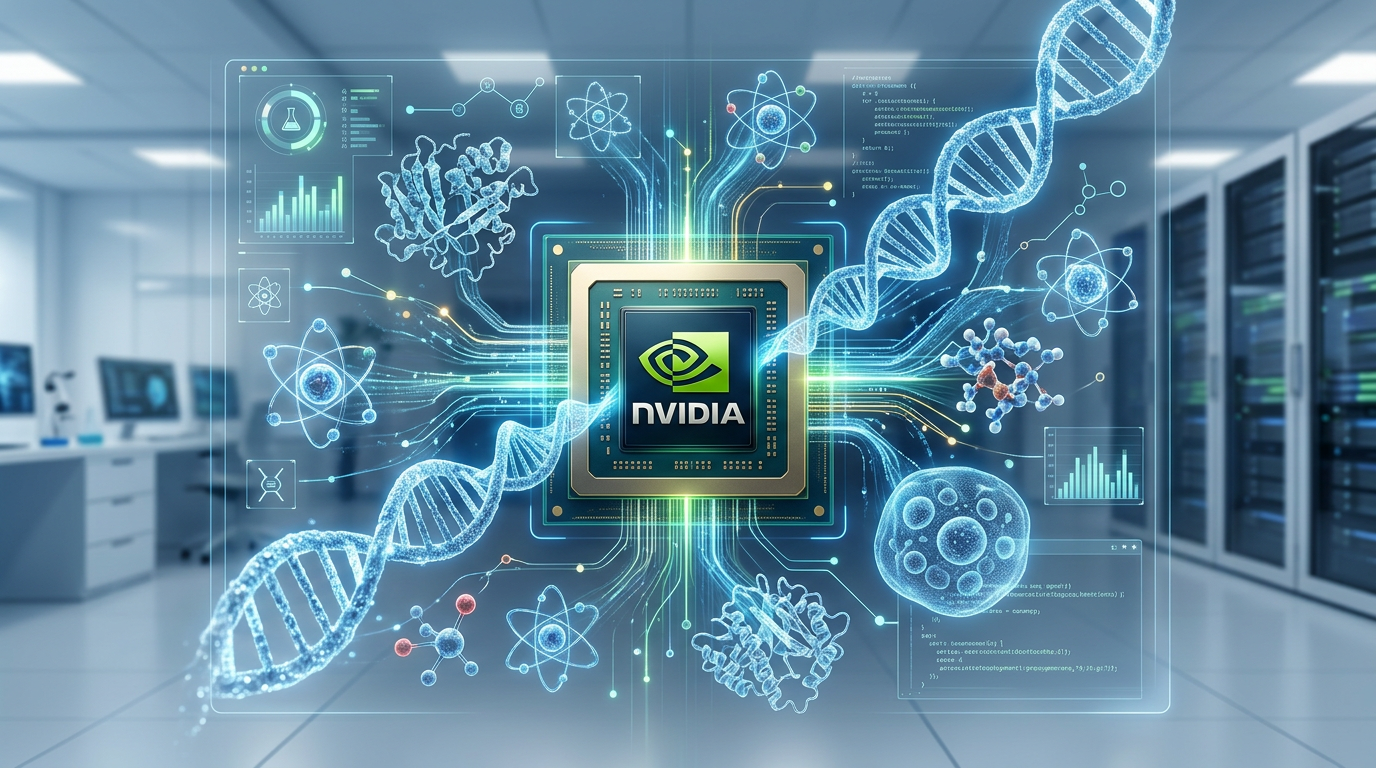
NVIDIA has announced the release of the BioNeMo Agent Toolkit, a software suite designed to provide artificial intelligence agents with specialized tools and skills for life sciences research. Announced on June 23, 2026, the toolkit integrates over a decade of the company’s life sciences libraries, open models, and computational tools. According to NVIDIA, the toolkit is already being adopted or integrated by more than 50 organizations, including Anthropic, OpenAI, Databricks, and the University of Washington’s Institute for Protein Design.
The toolkit is designed to turn general-purpose AI models into specialized assistants capable of executing scientific workflows in biology, chemistry, genomics, and drug discovery. By connecting reasoning foundation models with domain-specific computational tools, the toolkit allows agents to run experiments, analyze scientific data, and suggest research steps.
Technical Architecture and Core Software Components
The BioNeMo Agent Toolkit is powered by a combination of NVIDIA’s existing AI technologies and newly introduced frameworks, cooperating to establish a secure, reasoning-capable execution environment for AI agents:
- NVIDIA Nemotron: Open foundation models that serve as the reasoning core for AI agents, allowing them to determine which actions to take.
- NVIDIA NeMo: A framework utilized for model specialization and optimization.
- NVIDIA NIM Microservices: Containerized services that allow agents to call specific AI models and run localized tasks.
- NVIDIA OpenShell: A runtime that provides a controlled, secure, sandboxed execution environment for agents to run code, calculations, and policy controls.
- NVIDIA NemoClaw: An open-source reference stack and collection of open blueprints designed to run always-on AI agents (specifically wrapping the OpenClaw agent platform) more safely inside NVIDIA OpenShell sandboxes.
The toolkit is designed to help agents understand the correct inputs, outputs, and scientific meaning of biological data. Instead of requiring a general-purpose model to infer how to use a complex biology tool, the toolkit provides pre-configured, agent-callable interfaces for these libraries.
Supported Scientific Workflows
The toolkit includes specific libraries and skills that allow agents to complete multi-step scientific workflows. The company highlighted several key application areas:
Virtual Screening
Agents can automate the search for small-molecule drug candidates. The agent can generate molecular compounds, screen them, perform docking to target proteins, predict binding affinity, and filter the molecules for drug-like properties. The agent then outputs a prioritized list of candidates.
Genomic Analysis and Target Discovery
The toolkit uses NVIDIA Parabricks to accelerate raw sequencing data alignment and variant calling. Genomic foundation models score the effects of these variants, and the agent ranks the most disease-relevant genetic targets for further study.
Protein Binder Design and Validation
The toolkit provides tools to computationally design and validate target proteins before laboratory work begins. Through a collaboration with the University of Washington’s Institute for Protein Design (IPD), runtime performance for biodesign models like RoseTTAFold-All-Atom (RFAA) has been accelerated.
Biomedical Research Automation
The toolkit is designed to assist researchers by automating biomedical workflows. Using natural language, researchers can direct agents to synthesize and summarize scientific knowledge, review literature, analyze datasets, and coordinate computational steps.
Medical Imaging Analysis
AI agents can process, segment, and reason over medical imaging data, helping researchers identify biomarkers and generate evidence during clinical workflows.
Industry and Research Adoption
NVIDIA reported that dozens of companies across the technology, pharmaceutical, and software sectors are adopting or integrating the BioNeMo Agent Toolkit.
Frontier AI labs, including Anthropic and OpenAI, are integrating the toolkit to expand their models’ capabilities from conversational tasks to executing domain-specific scientific work. Scientific database and cloud platforms, such as Snowflake, Databricks, Benchling, Certara, and Seqera, are using the toolkit to let researchers query chemical datasets, launch reproducible workflows, and view biological insights directly within their existing platforms.
In the pharmaceutical and biotechnology space, Lilly and Natera are adopting the toolkit to scale repeatable agentic workflows. AI-native biology startups—including Boltz, Basecamp Research, Chai Discovery, Dyno, PerturbAI, and Proxima—are using the tools to build model-driven therapeutic designs.
Computer-aided drug discovery software providers like Dassault Systèmes, Cadence (OpenEye), and Schrödinger are incorporating the toolkit to orchestrate molecular generation, docking, and physical property predictions within their software. Additionally, lab automation and instrumentation companies, such as Automata, HighRes, Tecan, Thermo Fisher, and Medra, are linking physical lab systems with computational workflows powered by BioNeMo.
Cloud infrastructure providers including Baseten, Modal, and Nebius are hosting the BioNeMo skills as scalable APIs and managed compute services to support enterprise deployment.
Availability
The BioNeMo Agent Toolkit and its associated skills are currently available. Developers can access the resources through the official NVIDIA developer portal and GitHub.
- #AI Agents

Author
Raj M
Contributor
AI Systems Architect is a seasoned technology leader with over 15 years of experience in the IT industry working with Fortune 500 companies. With a solid foundation in multi-agent systems, open-source LLM infrastructure, and enterprise deployment, he excels at building scalable production-grade AI platforms.