
Mistral AI Expands Enterprise Platform with Vibe Rebrand, Forge Training, and OCR 4
Mistral AI has updated its enterprise AI product lineup, rebranding its flagship consumer-facing chat assistant Le Chat as "Vibe," launching its "Forge" custom model training platform, and introducing the "Mistral OCR 4" document intelligence model. These additions, alongside exi
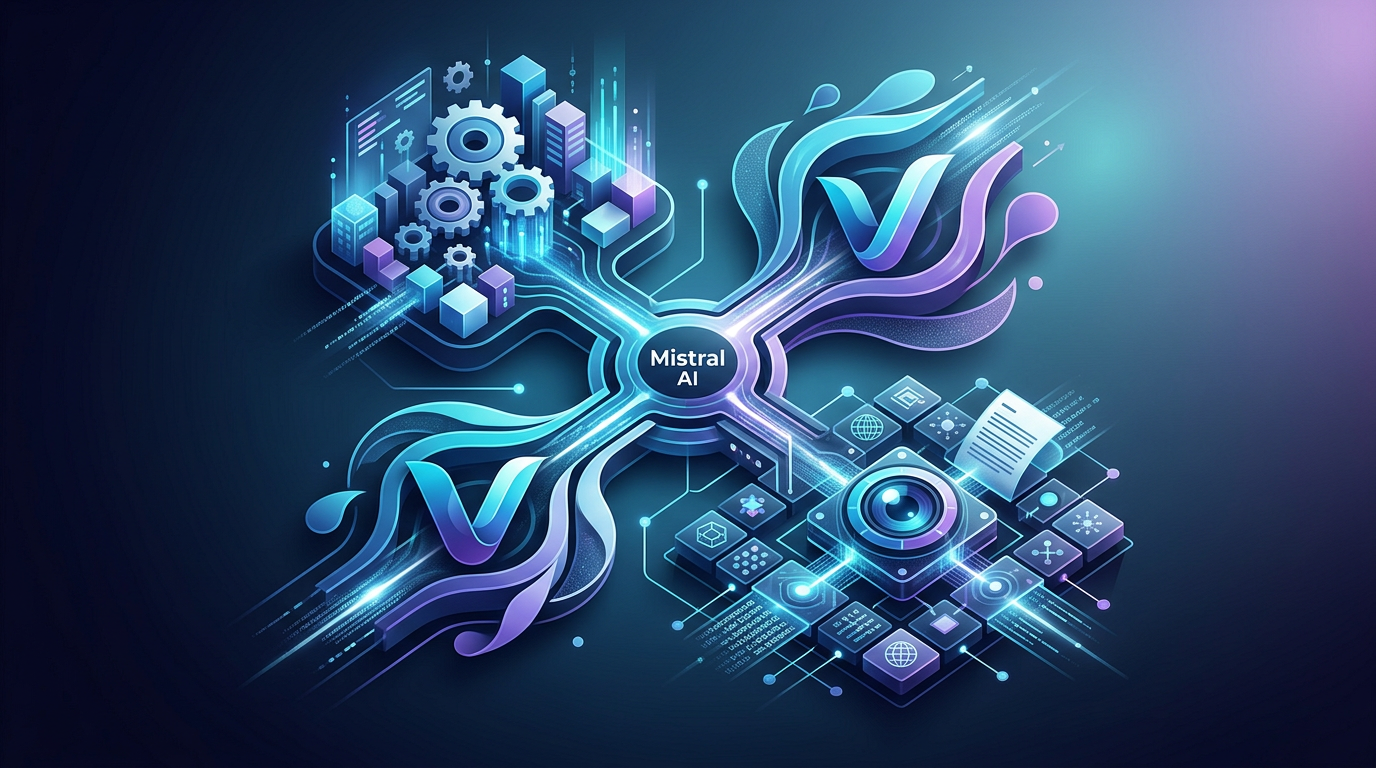
Mistral AI has updated its enterprise AI product lineup, rebranding its flagship consumer-facing chat assistant Le Chat as “Vibe,” launching its “Forge” custom model training platform, and introducing the “Mistral OCR 4” document intelligence model. These additions, alongside existing Mistral Studio and Compute services, form an integrated suite designed to let enterprises build, train, and run tailored AI systems. The French AI company has also updated its core model roster, led by the release of Mistral Medium 3.5.
Vibe: A Unified AI Agent for Work and Code
Mistral has transitioned its conversational AI assistant, Le Chat, into a rebranded, unified agent platform named Vibe. The product consolidates daily knowledge work and software development under a single subscription, shifting from a passive chatbot to an active, tool-using assistant capable of managing long-horizon tasks. It is structured around two distinct operational modes:
Work Mode
In Work Mode, Vibe functions as an enterprise agent for multi-step tasks. It is designed to map out action plans, secure user sign-offs, and execute processes across integrated toolsets while maintaining persistent memory and reusable skills. Key capabilities include:
- Enterprise Knowledge Search: Grounds its operations in organizational context by connecting to Google Workspace, Outlook, SharePoint, Slack, and GitHub through default connectors.
- Structured Data Analysis: Analyzes spreadsheets or connected databases to detect anomalies, patterns, and trends, rendering charts and dashboards directly inside the conversation interface.
- Document and Report Synthesis: Uses a Canvas tool to draft deliverables, ranging from one-page briefs to Request for Proposal (RFP) responses and board decks, which users can edit and export.
Code Mode (Vibe for Code)
Vibe for Code operates as an autonomous programming agent that builds features, fixes bugs, refactors code, and generates pull requests. The agent can run in parallel, isolated sandboxes in the cloud, allowing remote coding sessions to persist even when a developer’s local machine is turned off. Its developer interface spans:
- VS Code Integration: A dedicated extension brings the coding agent into the IDE side panel, allowing it to write tests matching existing codebase patterns, refactor modules, and document shipped code.
- Command Line Interface: The terminal-native Vibe CLI lets developers spawn sessions locally and teleport them to cloud sandboxes with a
/teleportcommand. - Enterprise Stack Connections: Connects directly with GitHub, GitLab, Jira, and Linear to align code changes with tracked issues and internal coding standards.
Forge: Enterprise Model Training and Alignment
For organizations that require proprietary, domain-specific AI systems, Mistral has launched Forge. Moving beyond simple API fine-tuning, Forge is a managed enterprise platform designed to control the entire model training pipeline on an organization’s proprietary data. The platform provides isolated environments and strict data residency controls to ensure proprietary datasets never train Mistral’s base models. Forge supports a multi-stage model lifecycle:
- Pre-Training from Scratch: Allows organizations to train models on large volumes of internal documentation, codebases, structured data, and operational records to internalize specialized terminology and reasoning patterns.
- Post-Training and Alignment: Supports post-training optimization through Supervised Fine-Tuning (SFT) and Direct Preference Optimization (DPO) to refine behavioral patterns.
- Reinforcement Learning (RL): Features RL pipelines designed to optimize models for executing complex, multi-step agentic workflows.
- Model Distillation: Enables developers to distill larger trained models into smaller, cost-efficient, and fast inference variants.
- Synthetic Data Generation: Generates synthetic datasets to supplement gaps in the training corpus.
Mistral OCR 4 and Updated Model Roster
Mistral has updated its lineup of foundation models, positioning them to feed directly into RAG pipelines, enterprise search, and agentic workflows.
Mistral OCR 4
This document intelligence model moves beyond raw text extraction to return a structured semantic map of entire documents. It natively supports PDF, DOC, PPT, and OpenDocument formats. Rather than outputting flat text, OCR 4 returns localized bounding boxes for every detected block, classifies block types (such as tables, equations, paragraphs, signatures, and titles), and provides inline confidence scores at the page and word level.
OCR 4 supports 170 languages across 10 language groups. It is deployable as a single container on self-hosted enterprise infrastructure to maintain strict data privacy.
// Example structural mapping returned by the OCR 4 API
{
  "block_type": "table",
  "bounding_box": [100, 150, 400, 450],
  "confidence_score": 0.985,
  "content": "HTML_table_structure_with_colspan_rowspan"
}
Mistral Medium 3.5
Mistral Medium 3.5 is the company’s dense 128-billion-parameter open-weight model with a 256,000-token context window. It serves as a single merged model handling instruction-following, reasoning, and coding within one set of weights. The model features a configurable reasoning effort per request, allowing it to toggle between fast instant replies and deep test-time compute runs. It replaces previous specialized models—such as Magistral for reasoning and Devstral 2 for coding—by consolidating these capabilities natively.
Studio, Compute, and Deployment Options
The new agents and training platforms interface directly with Studio, Mistral’s central environment for building, testing, and running AI applications. Studio provides agent orchestration, end-to-end observability, a unified AI registry, and guardrails to evaluate model outputs.
For back-end infrastructure, Mistral offers Compute, giving customers access to dedicated GPU clusters and frontier-scale orchestration infrastructure.
To accommodate varying privacy and security requirements, Mistral provides three deployment paths:
- Self-Hosted: Customers can deploy Studio and their models on virtual clouds, at the edge, or on-premises to keep data entirely self-contained.
- Mistral Cloud: Hosted on Mistral’s own infrastructure, with APIs running on EU-based servers.
- Cloud Partners: Access via major third-party cloud providers, including Google Cloud, AWS, Microsoft Azure, SAP, IBM, Snowflake, NVIDIA, and Outscale.
- #Startups

Author
Raman V
Contributor
Enterprise Solutions Leader is a transformation expert with over 15 years of experience in the IT industry working with Fortune 500 companies. With a solid foundation in large-scale application development and enterprise modernization, he excels at architecting robust, scalable platforms that drive operational efficiency.