
LightOnOCR-3 Folds Layout Boxes, Chart Tables and Image Captions Into One Small OCR Model
LightOn has released LightOnOCR-3 in 0.8B, 1B and 4B sizes under Apache 2.0, adding a grounding mode that returns labeled bounding boxes, chart data as HTML tables and short image descriptions alongside page transcription.
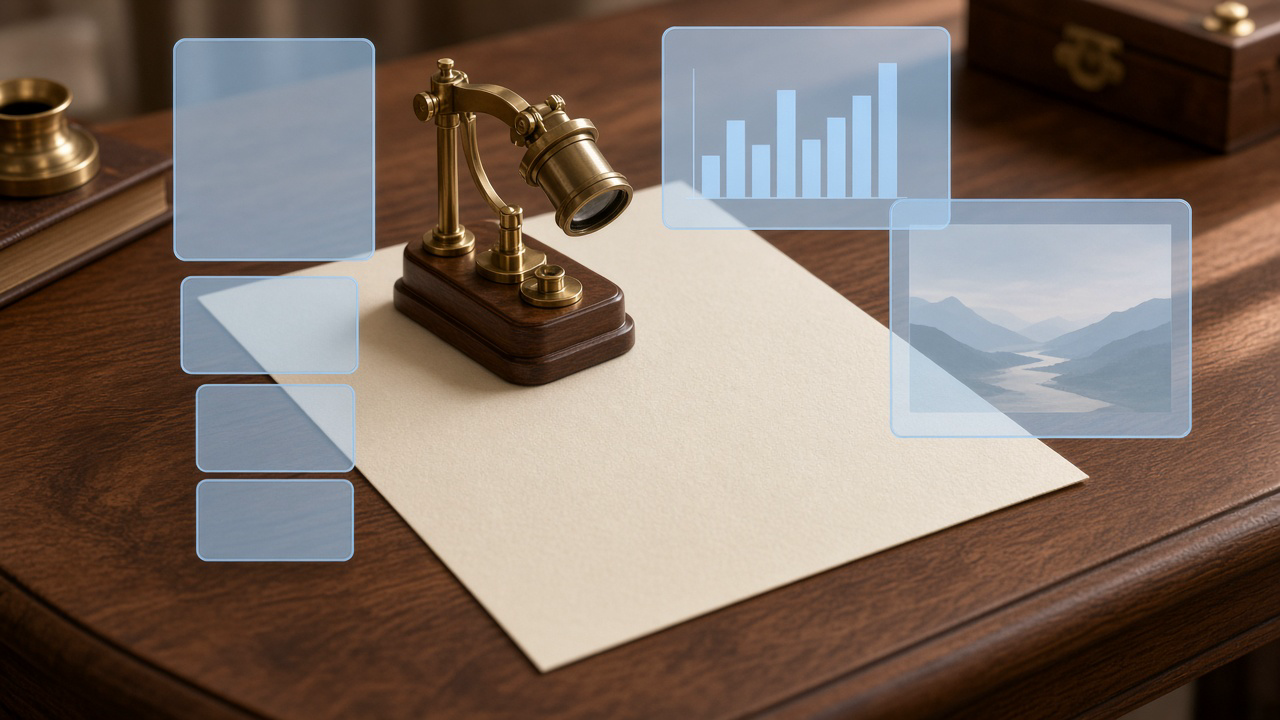
LightOn has released LightOnOCR-3, a family of compact optical character recognition models that read a page and also report where every element sits, what kind of element it is, and—for charts—the numbers behind it. The models come in 0.8-billion, 1-billion and 4-billion-parameter sizes, all under the Apache 2.0 license for research and commercial use. The Paris-based company published the weights on Hugging Face alongside a GitHub repository with a client, command-line tool, viewer and the scripts used to reproduce its benchmark scores.
Enterprise document pipelines often chain a text recognizer, a layout detector, a table parser and an image captioner, each with its own failure modes. LightOn pitches LightOnOCR-3 as a single end-to-end replacement that is easier to deploy and maintain.
Two prompts, two kinds of output
The models accept only two instructions. An empty prompt returns the full page as Markdown, matching the behavior of LightOnOCR-2, so existing users can upgrade without code changes. The prompt grounding switches on the new features. Each block of content is then prefixed with a compact marker giving its label and a bounding box in page coordinates normalized to 0–1000.
The label set has 16 classes, including text, title, list, header, footer, page number, footnote, caption, formula, code, table, image and chart, plus separate classes for logos in headers and footers and for marginal text. Image regions get a description of about ten words. Chart regions become an HTML table of their data points. LightOn says grounding adds about 25% more output tokens than plain transcription on the 4B model—1,433 versus 1,158 tokens per page on average—and that other instructions fall outside the training distribution.
Architecture choices across the three sizes
The 1B model keeps the LightOnOCR-2-1B architecture and is positioned as a drop-in upgrade for current deployments. The 0.8B and 4B models move to the Qwen3.5 vision-language architecture, which simplifies integration with standard tooling. The 4B checkpoint loads with Qwen3.5 classes in Transformers 5.2 or later and is meant to run with thinking disabled. LightOn also provides a vLLM serving recipe and recommends rendering PDFs at 400 DPI, capped at 2,048 pixels on the long side.
Benchmark standing against larger parsers
On olmOCR-Bench, LightOnOCR-3-4B scores 86.3 overall, 1.3 points behind Infinity Parser Pro, which lists 35.1 billion parameters, and 0.5 points ahead of Chandra 2 at the same 4B size. The 0.8B variant scores 85.5 and the 1B scores 84.5. On ParseBench, the 4B and 0.8B models rank first and second on the five-category score at 75.1 and 74.6, just ahead of Infinity Parser Pro at 74.3, with the 4B leading on charts and semantic formatting. On the French fr-bench-pdf2md set, the 4B leads at 74.1 and posts the best handwriting score in the comparison.
LightOn is candid about the limits of those numbers. Every benchmark it uses relies on edit distance, so equivalent encodings of a footnote can score differently. The team says it did not tailor training data to benchmark conventions but did apply normalization functions before scoring, and it publishes those functions so others can check how much they move results.
Speed and the training recipe
On a single H100 with vLLM, LightOn says LightOnOCR-3-4B is 19% faster on a single page than Chandra-OCR-2 and serves 21% more pages per second at each model’s benchmark settings, largely because its compact output uses about 14% fewer tokens. Rendering pages at 1,540 pixels instead of 400 DPI raises peak throughput to 4.78 pages per second on the 0.8B and 3.36 on the 4B.
Training combined supervised fine-tuning with reinforcement learning on verifiable rewards. The supervised mixture upweighted formula pages two times and tables three times, added handwriting and synthetic pages from the DocDuck library across more than 20 languages, and devoted 21.9% of samples to grounding. Building box labels required an ensemble of PaddleOCR, PP-DocLayoutV3, Docling and docTR detectors aligned against reference transcriptions, with Qwen3-VL-235B filling chart and image content under strict checks that reject fabricated tables. The reinforcement stage used GRPO on manually verified pages and averaged weights from several seeds.
For teams running retrieval-augmented generation over PDFs, the practical change is fewer moving parts: a sub-5B model that outputs text, structure and chart data in one pass, under a license that allows shipping it in commercial products.
- #LightOn
- #OCR
- #Document AI
- #Open Models
- #Vision Language Models

Author
Raj M
Contributor
AI Systems Architect is a seasoned technology leader with over 15 years of experience in the IT industry working with Fortune 500 companies. With a solid foundation in multi-agent systems, open-source LLM infrastructure, and enterprise deployment, he excels at building scalable production-grade AI platforms.