
H Company’s Holo4 Agents Switch Between GUI, Code, MCP, and APIs on One Model
On September 28, 2026, H Company released Holo4—27B dense and 35B-A3B MoE agentic models plus Holotron4 Nano—trained to click, code, and call tools across desktop, web, Android, sandboxes, and business APIs.
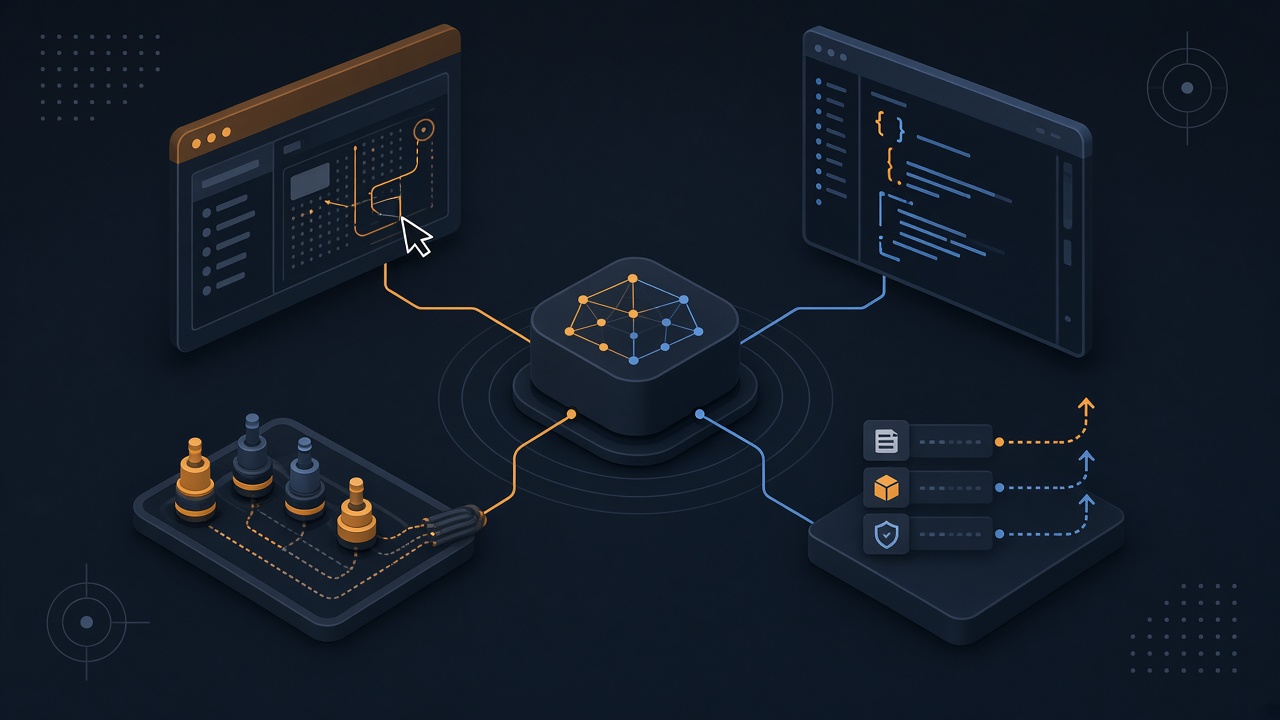
H Company announced Holo4 on September 28, 2026: a pair of agentic models—27B dense and 35B-A3B Mixture of Experts—plus an updated Holotron4 Nano built from NVIDIA Nemotron 3 Nano Omni. The company blog and Hugging Face companion post pitch the same idea from two angles. Most agentic models specialize in one interface: GUI agents go dark without a screen; tool-calling models stall in front of software that has no API. Holo4 is trained to pick whichever interface fits the step—clicks and typing on a screen, writing and running code, or calling MCP and HTTP tools—and to keep that choice inside one model called the same way on desktop, web, Android, code sandboxes, and business APIs.
Benchmark tables on the company newsroom page are the quantitative spine. On OSWorld computer tasks, Holo4 27B is reported at 85.2% with an estimated $0.08 per task at H Models API rates; the 35B-A3B MoE lands at 80.8% and $0.05. On the harder OSWorld 2.0 long-workflow set, Holo4 27B reaches 61.7% average partial score at about $1.22 per task, trailing Anthropic’s Opus 5.5 at 81.8% but at far lower cost and parameter count on H Company’s comparison. AutomationBench public-set scores are listed at 45.4% ($0.05) for 27B and 34.5% ($0.02) for 35B-A3B. AndroidWorld phone-app scores are 85.1% and 77.6%. Held-out Agentic Task Factory pools—web apps, MCP servers, and desktop apps generated from documentation and not used in training—show 27B ahead of its Qwen3.8 27B base across those slices. H Company also publishes the trajectories behind public-benchmark scores for replay and download.
Licensing is not uniform across the family, and that matters for anyone planning self-host. The Hugging Face card for Hcompany/Holo4-27B puts the 27B weights under CC BY-NC 4.0 (non-commercial), built on Alibaba’s Apache-2.0 Qwen3.8-27B base. The card for Hcompany/Holo4-35B-A3B releases the MoE weights under Apache License 2.0 on a Qwen3.6-35B-A3B base that is also Apache-2.0. Both sizes are available on the H Models API; weights ship in BF16, FP8, NVFP4, and 4-bit GGUF. Context length in the configs is listed at 262,144 tokens. Holotron4 Nano applies the same post-training stack to Nemotron 3 Nano Omni as a Nemotron Coalition follow-up to Holotron 3, with absolute gains cited on OSWorld CUA, AutomationBench MCP, PinchBench, and ALE Linux coding splits.
Training is described as a three-stage recipe. Supervised fine-tuning covers about 127B tokens, with roughly three quarters of that mass as successful agentic trajectories from the Agentic Task Factory—desktop-heavy, then web, MCP/API, and mobile—plus multimodal reasoning, GUI grounding, and text-only tool use. Asynchronous online reinforcement learning then trains two specialized LoRA experts (desktop/web versus terminal/MCP/API) before merging both experts back into the fine-tuned model at equal weight. The Agentic Task Factory itself is an internal pipeline that turns product docs and screenshots into environments, tasks, and verifiers; H Company says it has produced about 10,000 tasks across web, MCP, and desktop, keeping only tasks whose verifiers fail on the untouched seed, pass on a golden state, and reject near misses.
The harness rebuild is as much of the story as the weights. Feedback from OSWorld 2.0 failures drove a reliable long-horizon memory and a shell that runs on the desktop machine itself, so the agent can drive code and clicks through one tool surface. Qualitative demos contrast Holo4 27B with its Qwen3.8 27B base on FreeCAD Eiffel Tower and H-logo builds and on an unattended Pac-Man-style Godot game, counting tool calls and tokens under the same prompt and harness. H Company says optimized DSpark drafter checkpoints for faster inference are coming in the following days.
For Writeble’s ai-agents desk, Holo4 is the late-September computer-use drop that argues interface diversity—not just a bigger GUI specialist—is the product cut, with an explicit license split readers should read before they mirror weights.
- #AI Agents
- #Computer Use
- #Open Models
- #H Company
- #MCP

Author
Raj M
Contributor
AI Systems Architect is a seasoned technology leader with over 15 years of experience in the IT industry working with Fortune 500 companies. With a solid foundation in multi-agent systems, open-source LLM infrastructure, and enterprise deployment, he excels at building scalable production-grade AI platforms.